

The light pollution is considered to be one of the main causes of insect decline although it often goes unnoticed. Although it has been less studied than other problems, such as the pesticides or climate change, there are numerous studies that show their negative effects on these animals.
Artificial light sources, such as street lamps, road lights or vehicle lights, have an environmental impact in two ways: by glow in the skywhich occurs when artificial light illuminates the night sky, and by means of the ecological light pollutionwhich occurs when artificial light infiltrates terrestrial habitats without needing to reach the sky.
The sky's radiance extends beyond urban centres, encroaching on areas rich in biodiversity. It is estimated that the 88 % of the surface Europe experiences a glow in the sky with a light level at least 8 % higher than natural levels.
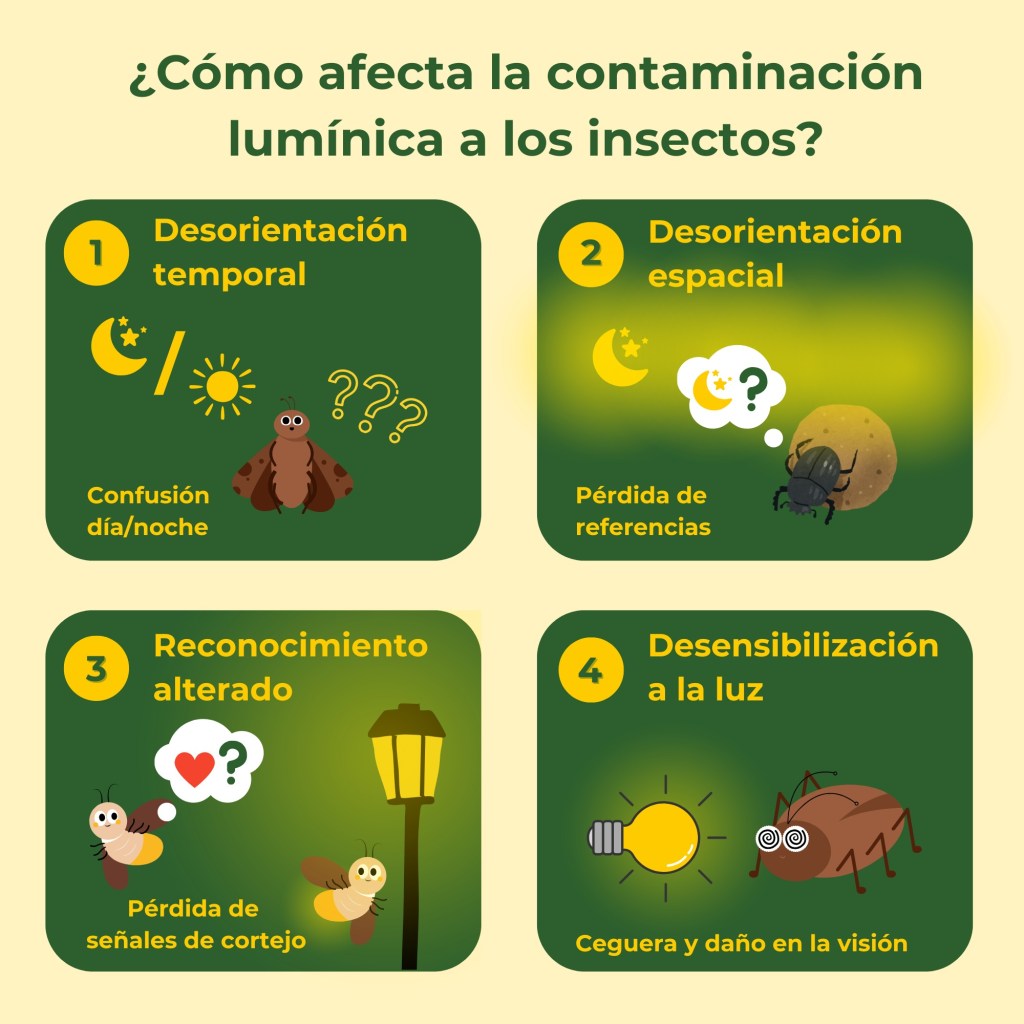
Light pollution alters the day/night cycles to which insects have adapted throughout their evolution, affecting both diurnal and nocturnal species in the following ways:
Temporal disorientation
Like vertebrates, insects, like vertebrates, are synchronise activities such as feeding, reproduction, and migration with the light cycles daily (circadian), monthly (circadian) and yearly (circadian). This synchronisation occurs thanks to light signals from the environment. When light pollution is sufficiently intense or persistent, these cycles are disturbed and insects lose their time reference. For example, continuous exposure to light has been found to inhibit pheromone release in female moths and reduce male attraction.
Spatial disorientation
During the night, insects use the light from the the Moon and the stars for orientation. Artificial lighting can interfere with this process in two ways: being confused with the light of the moon and the stars, and reducing their visibility.
As we explain in other articlea recent study suggests that the flight of insects around artificial light sources is an example of this disorientation. Accustomed to flying with their backs to the light in the sky both day and night, they try to reorient themselves in the presence of a nearby light, circling around it as a result. It is estimated that one third of the insects "attracted" to the light in this way die shortly thereafter due to exhaustion, overheating, collision, dehydration or predation.
In addition, it has been observed that increased sky glow affects species such as Scarabaeus satyrusa dung beetle that orients itself by using the light from the Milky Way and the Moon. Light pollution causes the loss of these references and causes the beetles to try to orient themselves with artificial ground lights instead.
Altered recognition
Light pollution also interferes with the ability of insects to recognise elements in their environment such as food sources, predators or conspecifics. For example, ladybirds of the species Coccinella septempunctata improve their ability to hunt aphids of the species Acyrthosiphon pisum in the presence of artificial lighting.

Species that communicate using light signals are particularly vulnerable. Many fireflies use flashes of light to attract mates. In the presence of light pollution, it has been observed that fireflies cease broadcasting light signals, or these are not perceived correctly by potential mates, which makes reproduction difficult.
Light desensitisation
Many nocturnal insects, such as some species of flies, bees, and cockroaches, have highly sensitive visual receptors to light. When exposed to high levels of artificial illumination, they may become temporarily blinded and even suffer permanent damage in their vision.
In addition to the direct effects on insects, light pollution also has indirect impactsemissions, such as altering the development of the plants on which they depend. Although more studies are needed to better understand its impact on insect populations, the current evidence is sufficient to understand that light pollution negatively affects them and that its reduction is essential for their conservation.
References
Desouhant, E., Gomes, E., et al. (2019). Mechanistic, ecological, and evolutionary consequences of artificial light at night for insects: review and prospective. Entomologia Experimentalis et Applicata, 167(1), 37-58.
Fabian, S. T., Sondhi, Y., et al. (2024). Why flying insects gather at artificial light. Nature Communications, 15(1), 689.
Foster, J. J., Tocco, C., et al. (2021). Light pollution forces a change in dung beetle orientation behaviour. Current Biology, 31(17), 3935-3942.
Owens, A. C., & Lewis, S. M. (2018). The impact of artificial light at night on nocturnal insects: a review and synthesis. Ecology and evolution, 8(22), 11337-11358.
Owens, A. C., Cochard, P., et al. (2020). Light pollution is a driver of insect declines. Biological Conservation, 241, 108259.

 English
  Spanish