

Wasps are commonly defined as species of the order Hymenoptera that are neither bees nor ants. This category includes more than 120,000 known species, with very different appearances and lifestyles.
Characteristics of wasps
Wasps share some unique characteristics with other hymenopterans. For example, they have hook-like structures on their wings, called hamuli, which connect the two pairs of wings during flight. They are also haplodiploid, i.e. females hatch from fertilised eggs and males from unfertilised eggs. What we remember most about them is that they also have an ovipositor (egg-laying structure) specialised as a stinger, or for depositing eggs in or on other living things.
Within the diversity of wasps, we find the symphytes, popularly known as sawflies or saw wasps. These lack the characteristic "wasp waist" and are sometimes considered a separate group. Other wasps are so closely related to bees that the only characteristic that differentiates them from bees is the absence of branching hairs, which are present in bees.
In terms of their life cycle, wasps go through a complete metamorphosis. Their eggs and larvae can develop in various ways: in nests, or by feeding on other living things, either externally or from within. It is important to note that only about 1000 wasp species are social and defensive around their nests.
Where do they live?
With such a variety of species, it is not surprising that wasps can be found everywhere. In arid landscapes, such as those of some Mediterranean areas, we can find pollen wasps and velvet ants (of the Mutillidae family). The latter owe their name to their resemblance to ants, as the females are wingless.
In tropical forests, mammoth wasps (Scoliidae), large species that parasitise beetles, and fig wasps (Agaonidae), smaller than 2 mm, develop inside fig fruits.
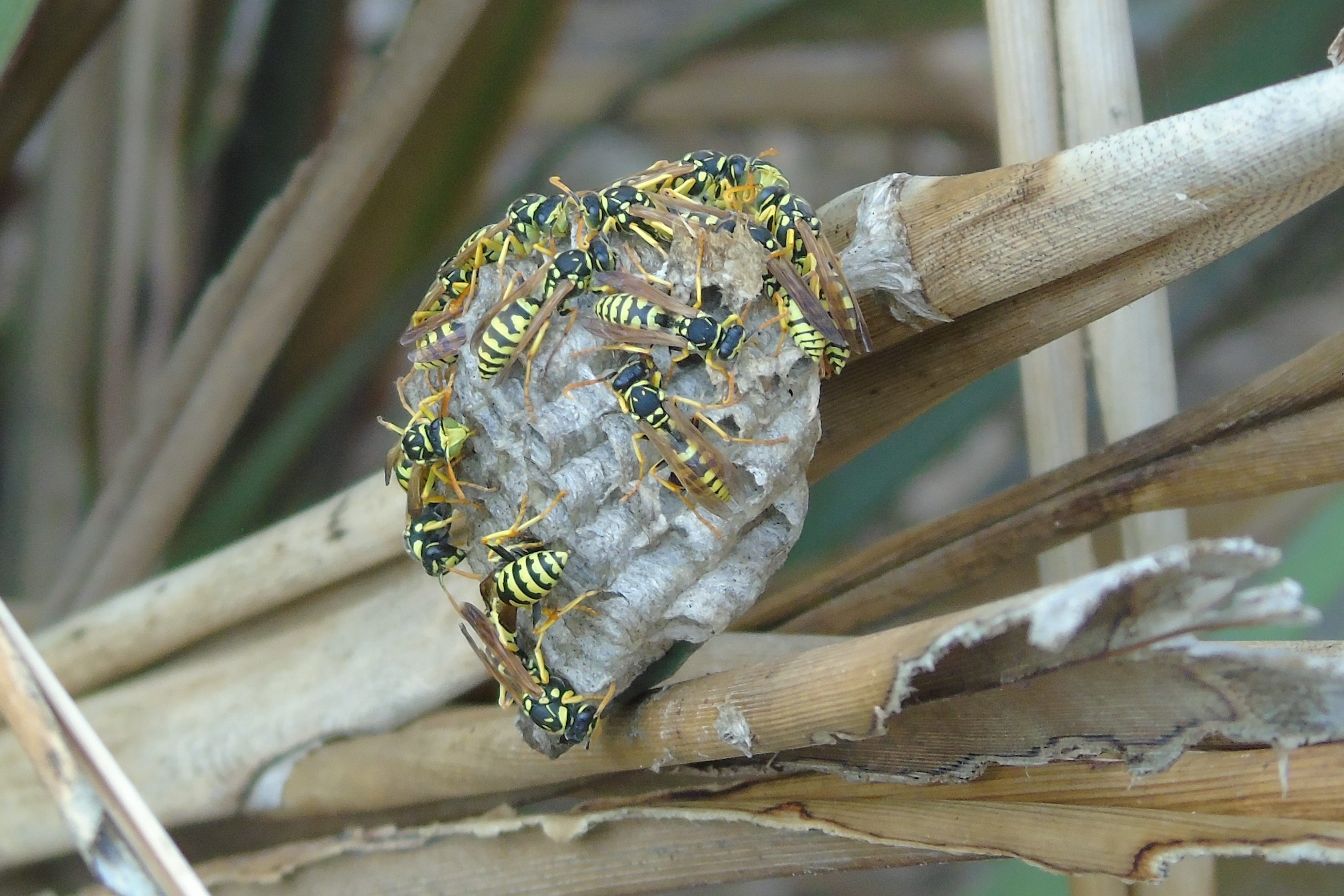
In built-up areas, the best known are wasps of the family Vespidae, which include the social species that build the famous paper or mud nests.
There are even aquatic or semi-aquatic species that parasitise aquatic insects. One example is Caraphractus cinctus, which parasitizes diving beetles.
What do they eat?
Their diet is equally varied. Symphytes are mainly vegetarian, feeding on almost any plant tissue. They usually feed from the outside of the plant, but can also feed from the inside, such as larvae that develop in galls or wood. However, there are always exceptions: some symphytes parasitise wood-dwelling animals, and there are wasp species with plant diets that are not symphytes.
Most wasps are parasites or predators of animals and feed on other insects such as caterpillars, moths and butterflies, beetles, flies, aphids and other wasps, as well as spiders. Parasitic species may deposit eggs near or inside the host, often using specialised ovipositors that may be even longer than the wasp itself. Many also use stingers to paralyse their prey and facilitate laying.

There are species that do not parasitise directly, but usurp the nests or food sources of others, which can cause their death directly or indirectly by starvation.
Finally, social species hunt their prey and gather organic matter to feed their offspring.
While larvae usually require protein, adult wasps tend to feed on sugary substances such as nectar, aphid "honeydew" or sap.
Ecological importance
Many wasps act as pollinators, and there are even plant species that have co-evolved to be pollinated by one or a few wasp species. Pollen wasps and fig wasps are two examples of this role.
Those that feed on dead organic matter and those that live in wood contribute to nutrient recycling.
Predatory and parasitic species are essential for controlling populations of other insects. In fact, several species are used in pest control, for example, Cotesia glomerata was introduced in the United States to control the cabbage butterfly, Pieris rapae.
In turn, wasps are a source of food for other animals, such as mammals, birds and spiders.
As you can see, wasps play a vital role in ecosystems, and there is little reason to fear them... unless you are an insect.

 English
  Spanish