

Flies constitute the order Diptera, one of the most diverse insect groups, with approximately 160.000 species described worldwide. Its name comes from Greek and means “two wings”, referring to the characteristic that distinguishes them.
General characteristics
The dipterans vary greatly in size, from less than 1 mm
up to 6 cm. Their most characteristic feature is that they possess only one pair of membranous wings. Their second pair of wings has evolved into small club-shaped organs called halter, which help them to stabilise their flight and perform aerial manoeuvres. Although most fly, there are some exceptions of dipterans that lack wings.
Most adult dipterans possess a proboscis, a tubular structure adapted for suction. In blood-feeding species, this proboscis is modified to pierce tissues as well as suck fluids. Interestingly, some adult dipterans do not feed, so their mouthparts have been reduced.

Flies are holometabolous insects, that is, they undergo complete metamorphosis and pass through the pupal stage. The cycle begins with the laying of eggs, which are normally located near the habitat of the future larva. Most larvae live independently, but there are also species whose larvae develop as parasites within other organisms. Some flies are even viviparous, with the larvae beginning development inside the female until she gives birth to them.
Where do they live?
The greatest diversity of diptera is concentrated in the regions Tropical, but their adaptability has allowed them to colonise as far as the Arctic, being absent only in the open seas and the interior of glaciers.
The larvae of dipterans are very versatile regarding their habitat. Many are aquatic or semi-aquatic, dwelling in humid environments, stagnant or moving bodies of water, or associated with plant tissues and decomposing matter. However, they can also be found in drier environments, such as among gravel or sand.
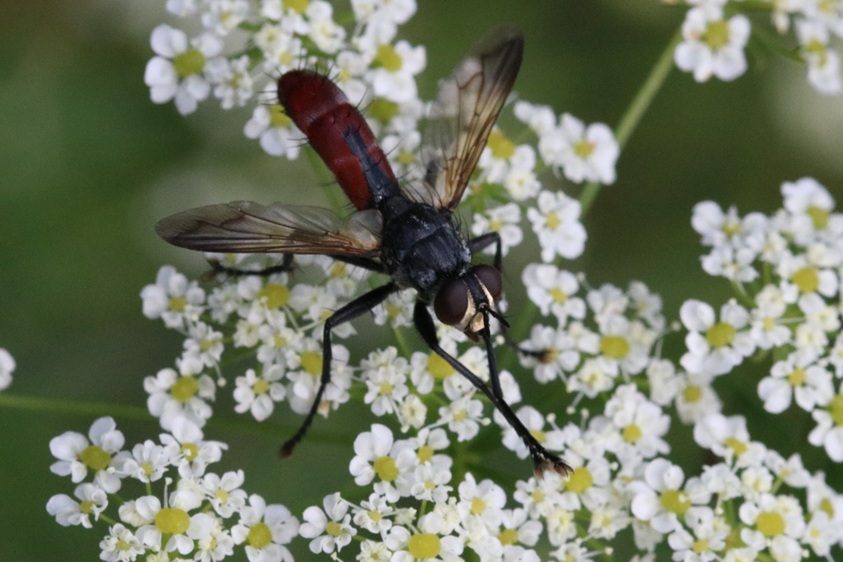
Adults are predominantly terrestrial, but they can also be found in a variety of environments. They are observed, for example, on the banks of streams and lakes, amongst decaying matter, around vegetation, and forming swarms to reproduce in specific spots such as hilltops, around trees, or in illuminated areas over bodies of water.
What do they eat?
The larvae have adapted to consume virtually any type of food. For example, crane fly larvae feed on plants, debris Vegetables and mushrooms. Many chironomid larvae feed on organic matter decomposing and associated micro-organisms. There are also larvae predators, such as those of vermileonids, which construct ingenious traps to hunt their prey, and parasite, like the larvae of bombyliidae, which feed on other insects.
Adults, not needing to grow, have a diet more focused on Energy acquisition. They may not feed at all or may consume nectar, honeydew, pollen, blood, haemolymph (the «blood» of invertebrates) or other organic matter which they can dissolve with their saliva before sucking it up. Some groups are also predators, such as the voracious Asilidae, capable of hunting prey that is up to twice their size.
Ecological importance
In both terrestrial and aquatic ecosystems, a large number of dipteran species act as decomposers, recycling the nutrients by processing organic matter.
They are also essential components of the food chain. They serve as important primary consumers, and their parasitic and predatory species help control populations of other organisms. In turn, they are a crucial food source for other invertebrates, fish, amphibians, reptiles, and mammals.

make a great contribution to the pollination. of plants, which they visit to obtain pollen and nectar. Numerous plants have evolved adaptations specifically for pollination by certain species of dipterans. Furthermore, in Arctic environments and alpine zones, they represent a very high proportion of pollinators.
Unfortunately, their interaction with humans is more known for transmitting pathogens that cause diseases such as malaria, dengue, or leishmaniasis. However, they have also been very useful to us as organisms Model in studies of physiology and genetics, being the most well-known Drosophila melanogaster and Aedes aegypti. Furthermore, they are relevant in environmental toxicity studies in aquatic ecosystems, as is the case with chironomids.
As expected, the importance of diptera goes far beyond preventing us from sleeping during summer naps or nights.

 English
  Spanish